
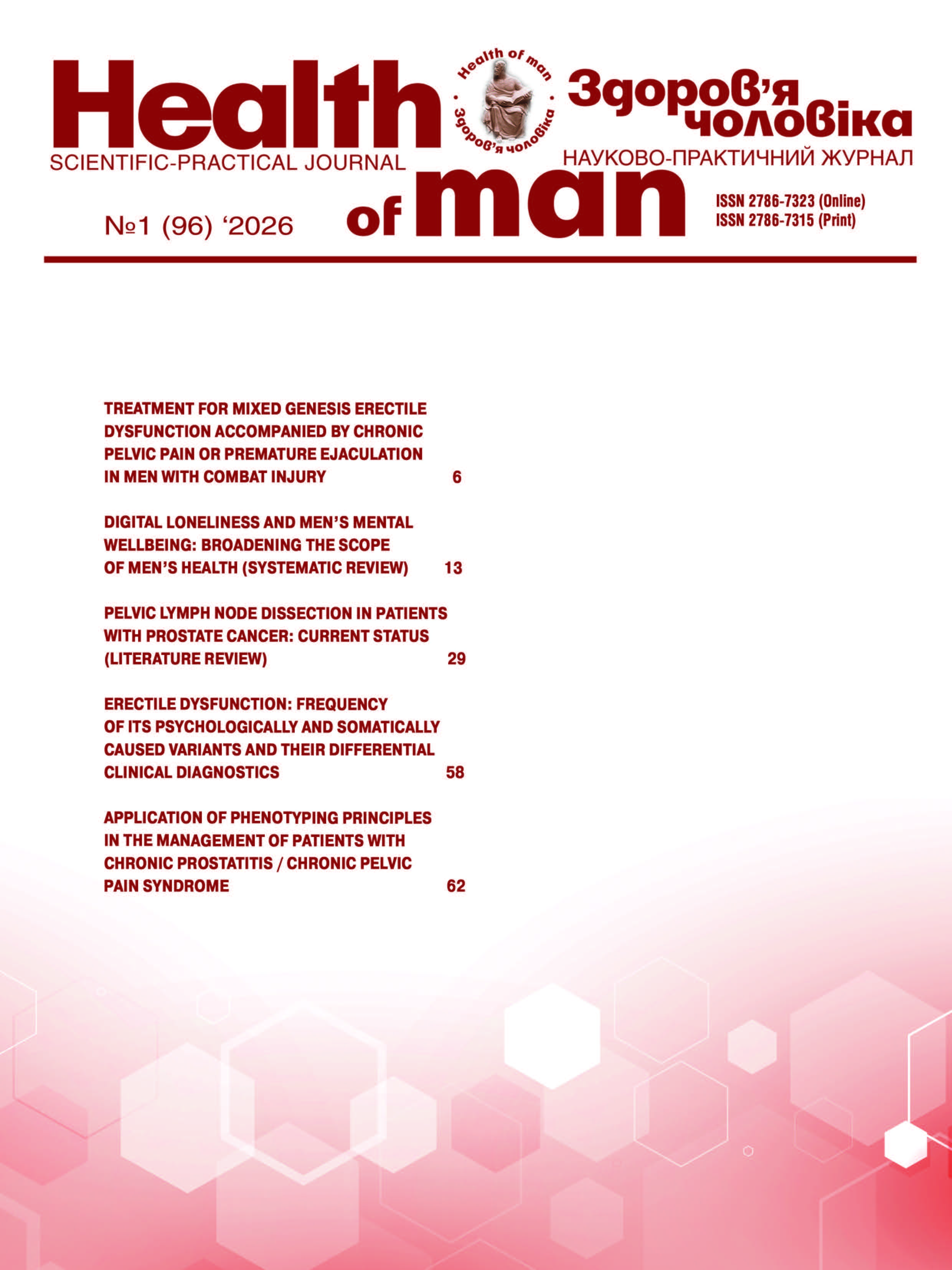
Тазова лімфодисекція у хворих на рак передміхурової залози: сучасний стан проблеми (Огляд літератури)
##plugins.themes.bootstrap3.article.sidebar##
##plugins.themes.bootstrap3.article.main##
Анотація
Тазова лімфодисекція (ТЛД) залишається важливим методом точного стадіювання раку передміхурової залози (РПЗ) і може забезпечувати онкологічний бенефіт при видаленні нодальних метастазів. Розширена ТЛД (рТЛД) підвищує точність стадіювання та покращує виявлення уражених лімфатичних вузлів, проте асоційована з підвищеним ризиком періопераційних ускладнень. Роль позитронно-емісійної томографії / комп’ютерної томографії з простатоспецифічним мембранним антигеном (ПСМА ПЕТ / КТ) у первинному стадіюванні РПЗ залишається контроверсійною, особливо щодо рішення про відмову від ТЛД.
Мета дослідження: проаналізувати сучасні роботи щодо доцільності виконання ТЛД та рТЛД у пацієнтів із локалізованим РПЗ проміжного й високого ризику, оцінити онкологічний бенефіт, частоту періопераційних ускладнень і порівняти патоморфологічні результати з даними ПСМА ПЕТ / КТ щодо виявлення інвазії лімфатичних вузлів (ІЛВ).
Збір доказів. Виконано систематичний огляд PubMed, Embase та Scopus із червня 2011 р. до червня 2025 р. Аналізували роботи з обмеженою, стандартною та рТЛД, оцінювали переваги й недоліки різних підходів, а також частоту післяопераційних ускладнень. Для ПСМА ПЕТ / КТ визначали чутливість, специфічність, позитивну (ППЦ) та негативну прогностичну цінність (НПЦ) у виявленні ІЛВ.
Синтез доказів. У фінальний синтез включено 59 робіт. У групі високого ризику негативний результат ПСМА ПЕТ / КТ не дає змоги безпечно відмовитися від ТЛД. Загальна чутливість, специфічність, ППЦ та НПЦ ПСМА ПЕТ / КТ для виявлення ІЛВ становили 58, 95, 79 та 87%; у високоризиковій групі – 51, 93, 73 та 81% відповідно.
Висновки. Доцільність проведення ТЛД залишається контроверсійною. Європейська асоціація урологів рекомендує ТЛД на підставі категорій ризику із сильними рекомендаціями проведення рТЛД у пацієнтів високого ризику. ПСМА ПЕТ / КТ забезпечує високу точність первинного нодального стадіювання. У низькоризикових пацієнтів висока НПЦ може допомогти уникнути непотрібних ТЛД, тоді як у високоризикових негативний результат ПСМА ПЕТ / КТ не виключає необхідності ТЛД.
##plugins.themes.bootstrap3.article.details##

Ця робота ліцензується відповідно до Creative Commons Attribution 4.0 International License.
Автори зберігають авторське право, а також надають журналу право першого опублікування оригінальних наукових статей на умовах ліцензії Creative Commons Attribution 4.0 International License, що дозволяє іншим розповсюджувати роботу з визнанням авторства твору та першої публікації в цьому журналі.
Посилання
Sawada A, Nishimoto K, Akamatsu S, Kubota M, Sumiyoshi T, Saito R, et al. Reevaluating the therapeutic role of extended lymph node dissection in the era of robot-assisted radical prostatectomy. Sci Rep. 2025;15(1):17680. doi: 10.1038/s41598-025-00926-2.
Bruins HM, Veskimae E, Hernandez V, Imamura M, Neuberger MM, Dahm P, et al. The impact of the extent of lymphadenectomy on oncologic outcomes in patients undergoing radical cystectomy for bladder cancer: A systematic review. Eur Urol. 2014;66(6):1065-77. doi: 10.1016/j.eururo.2014.05.031.
Capitanio U, Becker F, Blute ML, Mulders P, Patard JJ, Russo P, et al. Lymph node dissection in renal cell carcinoma. Eur Urol. 2011;60(6):1212-20. doi: 10.1016/j.eururo.2011.09.003.
Cotlar AM, Dubose JJ, Rose DM. History of surgery for breast cancer: Radical to sublime. Curr Surg. 2003;60(3):329-37. doi: 10.1016/S0149-7944(02)00777-8.
Halsted WS. I. The Results of Operations for the Cure of Cancer of the Breast Performed at the Johns Hopkins Hospital from June, 1889, to January, 1894. Ann Surg. 1894;20(5):497-555. doi: 10.1097/00000658-189407000-00075.
Pedrazzoli S, DiCarlo V, Dionigi R, Mosca F, Pederzoli P, Pasquali C, et al. Standard versus extended lymphadenectomy associated with pancreatoduodenectomy in the surgical treatment of adenocarcinoma of the head of the pancreas: A multicenter, prospective, randomized study. Lymphadenectomy Study Group. Ann Surg. 1998;228(4):508-17. doi: 10.1097/00000658-199810000-00007.
Sim FH, Taylor WF, Pritchard DJ, Soule EH. Lymphadenectomy in the management of stage I malignant melanoma: A prospective randomized study. Mayo Clin Proc. 1986;61(9):697-705. doi: 10.1016/s0025-6196(12)62768-2.
Touijer KA, Sjoberg DD, Benfante N, Laudone VP, Ehdaie B, Eastham JA, et al. Limited versus extended pelvic lymph node dissection for prostate cancer: A randomized clinical trial. Eur Urol Oncol. 2021;4(4):532-39. doi: 10.1016/j.euo.2021.03.006.
Gervasoni JE Jr, Sbayi S, Cady B. Role of lymphadenectomy in surgical treatment of solid tumors: An update on the clinical data. Ann Surg Oncol. 2007;14(9):2443-62. doi: 10.1245/s10434-007-9360-5.
Tilki D, Chen MH, Wu J, Huland H, Graefen M, D’Amico AV. Adjuvant versus early salvage radiation therapy after radical prostatectomy for pN1 prostate cancer and the risk of death. J Clin Oncol. 2022;40(20):2186-92. doi: 10.1200/JCO.21.02800.
Mottet N, van den Bergh RCN, Briers E, Van den Broeck T, Cumberbatch MG, De Santis M, et al. EAU-EANMESTRO-ESUR-SIOG Guidelines on Prostate Cancer-2020 Update. Part 1: Screening, diagnosis, and local treatment with curative intent. Eur Urol. 2021;79(2):243-62. doi: 10.1016/j.eururo.2020.09.042.
Roberts MJ, Gandaglia G, Oprea-Lager DE, Stranne J, Cornford P, Tilki D, et al. Pelvic Lymph Node Dissection in Prostate Cancer: Evidence and Implications. Eur Urol. 2025;87(6):619-21. doi: 10.1016/j.eururo.2025.03.004.
Gandaglia G, Barletta F, Robesti D, Scudery S, Rajwa R, Gomez Rivas J, et al. Identification of the optimal candidates for nodal staging with extended pelvic lymph node dissection among prostate cancer patients who underwent preoperative prostate-specific membrane antigen positron emission tomography. External validation of the memorial sloan kettering cancer center and briganty nomograms and development of a novel tool. Eur Urol Oncol. 2023;6(6):543-52. doi: 10.1016/j.euo.2023.05.003.
Gandaglia G, Ploussard G, Valerio M, Mattei A, Fiori C, Fossati N, et al. A novel nomogram to identify candidates for extended pelvic lymph node dissection among patients with clinically localized prostate cancer diagnosed with magnetic resonance imaging-targeted and systematic biopsies. Eur Urol. 2019;75(3):506-14. doi: 10.1016/j.eururo.2018.10.012.
Stabile A, Pellegrino A, Mazzone E, Cannoletta D, de Angelis M, Barletta F, et al. Can negative prostate-specific membrane antigen positron emission tomography/computed tomography avoid the need for pelvic lymph node dissection in newly diagnosed prostate cancer patients? A systematic review and meta-analysis with backup histology as reference standard. Eur Urol Oncol. 2022;5(1):1-17. doi: 10.1016/j.euo.2021.08.001.
Roberts MJ, Yaxley JW, Stranne J, van Oort IM, Tilki D. Is extended pelvic lymph node dissection REALLY required for staging of prostate cancer in the PSMA-PET era? Prostate Cancer Prostatic Dis. 2025;28(2):345-7. doi: 10.1038/s41391-024-00821-3.
Incesu RB, Preisser F, Nohe F, Maurer T, Graefen M, Tilki D. Negative PSMA PET can be used to avoid unnecessary pelvic lymph node dissection in intermediate risk prostate cancer. Prostate Cancer Prostatic Dis. 2025;28(4):874-8. doi: 10.1038/s41391-024-00930-z.
Esen T, Esen B, Yamaoh K, Selek U, Tilki D. De-escalation of therapy for prostate cancer. Am Soc Clin Oncol Educ Book. 2024;44(2):e430466. doi: 10.1200/EDBK_430466.
Fossati N, Willemse PM, Van den Broeck T, van den Bergh RCN, Yuan CY, Briers E, et al. The benefits and harms of different extents of lymph node dissection during radical prostatectomy for prostate cancer: A systematic review. Eur Urol. 2017;72(1):84-109. doi: 10.1016/j.eururo.2016.12.003.
Preisser F, van den Bergh RCN, Gandaglia G, Ost P, Surcel CI, Sooriakumaran P, et al. Effect of extended pelvic lymph node dissection on oncologic outcomes in patients with D’Amico intermediate and high risk prostate cancer treated with radical prostatectomy: A multi-institutional study. J Urol. 2020;203(2):338-43. doi: 10.1097/JU.0000000000000504.
Pathak RA, Hemal AK. Developing a personalized template for lymph node dissection during radical prostatectomy. Transl Androl Urol. 2018;7(4):498-504. doi: 10.21037/tau.2018.03.19.
Esen T, Kılıç M, Seymen H, Acar Ö, Demirkol MO. Can Ga-68 PSMA PET/CT replace conventional imaging modalities for primary lymph node and bone staging of prostate cancer? Eur Urol Focus. 2020;6(2):218-20. doi: 10.1016/j.euf.2019.05.005.
Hofman MS, Lawrentschuk N, Francis RJ, Tang C, Vela I, Thomas P, et al. Prostate-specific membrane antigen PET-CT in patients with high-risk prostate cancer before curative-intent surgery or radiotherapy (proPSMA): a prospective, randomised, multicentre study. Lancet. 2020;395(10231):1208-16. doi: 10.1016/S0140-6736(20)30314-7.
Pienta KJ, Gorin MA, Rowe SP, Carroll PR, Pouliot F, Probst S, et al. A phase 2/3 prospective multicenter study of the diagnostic accuracy of prostate specific membrane antigen PET/CT with 18F-DCFPyL in prostate cancer patients (OSPREY). J Urol. 2021;206(1):52-61. doi: 10.1097/JU.0000000000001698.
Hope TA, Eiber M, Armstrong WR, Juarez R, Murthy V, Lawhn-Heath C, et al. Diagnostic accuracy of 68Ga-PSMA-11 PET for pelvic nodal metastasis detection prior to radical prostatectomy and pelvic lymph node dissection: A multicenter prospective phase 3 imaging trial. JAMA Oncol. 2021;7(11):1635-42. doi: 10.1001/jamaoncol.2021.3771.
Keegan KA, Cookson MS. Complications of pelvic lymph node dissection for prostate cancer. Curr Urol Rep. 2011;12(3):203-8. doi: 10.1007/s11934-011-0179-z.
Cacciamani GE, Maas M, Nassiri N, Ortega D, Gill K, Dell’Oglio P, et al. Impact of pelvic lymph node dissection and its extent on perioperative morbidity in patients undergoing radical prostatectomy for prostate cancer: A comprehensive systematic review and meta-analysis. Eur Urol Oncol. 2021;4(2):134-49. doi: 10.1016/j.euo.2021.02.001.
Ploussard G, Briganti A, de la Taille A, Haese A, Heidenreich A, Menon M, et al. Pelvic lymph node dissection during robot-assisted radical prostatectomy: Efficacy, limitations, and complications – a systemic review of the literature. Eur Urol. 2014;65:7-16. doi: 10.1016/j.eururo.2013.03.057.
Golovko S, Balabanyk V. Frequency and consequences of lymphocele formation after extended lymphdissection in patients undergoing open retropubic prostatectomy. Health Man. 2022;(1-2):27-32. doi: 10.30841/2307-5090.1-2.2022.263902.
Castro P, Arantes PBO, Martins YMR, Reis MNM, Drummond-Lage AP, Wainstein AJA. Complications of extended pelvic lymph node dissection in patients undergoing minimally invasive radical prostatectomy: Analysis and risk factors. Prostate Cancer. 2022;2022:7631903. doi: 10.1155/2022/7631903.
Grande P, Di Pierro GB, Mordasini L, Ferrari M, Würnschimmel C, Danuser H, et al. Prospective randomized trial comparing titanium clips to bipolar coagulation in sealing lymphatic vessels during pelvic lymph node dissection at the time of robot-assisted radical prostatectomy. Eur Urol. 2017;71(2):155-8. doi: 10.1016/j.eururo.2016.08.006.
Patel HD, Faisal FA, Trock BJ, Joice GA, Schwen ZR, Pierorazio PM, et al. Effect of pharmacologic prophylaxis on venous thromboembolism after radical prostatectomy: The PREVENTER randomized clinical trial. Eur Urol. 2020;78(3):360-8. doi: 10.1016/j.eururo.2020.05.001.
Agarwal PK, Sammon J, Bhandary A, Dabaja A, Diaz M, Dusik-Fenton S, et al. Safety profile of robot-assisted radical prostatectomy: a standardized report of complications in 3317 patients. Eur Urol. 2011;59(5):684-98. doi: 10.1016/j.eururo.2011.01.045.
Sebben M, Tafuri A, Shakir A, Pirozzi M, Processali T, Rizzetto R, et al. The impact of extended pelvic lymph node dissection on the risk of hospital readmission within 180 days after robot assisted radical prostatectomy. World J Urol. 2020;38(11):2799-809. doi: 10.1007/s00345-020-03094-2.
Clinckaert A, Callens K, Cooreman A, Bijnens A, Moris L, Van Calster C, et al. The prevalence of lower limb and genital lymphedema after prostate cancer treatment: A systematic review. Cancers (Basel). 2022;14(22):5667. doi: 10.3390/cancers14225667.
Morizane S, Honda M, Fukasawa S, Komaru A, Inokuchi J, Eto M, et al. Comparison of the diagnostic efficacy and perioperative outcomes of limited versus extended pelvic lymphadenectomy during robot-assisted radical prostatectomy: a multi-institutional retrospective study in Japan. Int J Clin Oncol. 2018;23(3):568-75. doi: 10.1007/s10147-017-1223-x.
Dong B, Zhan H, Luan T, Wang J. The role and controversy of pelvic lymph node dissection in prostate cancer treatment: a focused review. World J Surg Oncol. 2024;22(1):68. doi: 10.1186/s12957-024-03344-2.
Haiquel L, Cathelineau X, Sanchez-Salas R, Macek P, Secin F. Pelvic lymph node dissection in high-risk prostate cancer. Int Braz J Urol. 2022;48(1):54-66. doi: 10.1590/S1677-5538.IBJU.2020.1063.
Touijer KA, Vertosick EA, Sjoberg DD, Liso N, Nalavenkata S, Melao B, et al. Pelvic lymph node dissection in prostate cancer: Update from a randomized clinical trial of limited versus extended dissection. Eur Urol. 2025;87(2):253-60. doi: 10.1016/j.eururo.2024.10.006.
Furubayashi N, Negishi T, Uozumi T, Shiraishi K, Taguchi K, Shimokawa M, et al. Eliminating microscopic lymph node metastasis by performing pelvic lymph node dissection during radical prostatectomy for prostate cancer. Mol Clin Oncol. 2020;12(2):104-10. doi: 10.3892/mco.2019.1965.
Briganti A, Abdollah F, Nini A, Suardi N, Gallina A, Capitanio U, et al. Performance characteristics of computed tomography in detecting lymph node metastases in contemporary patients with prostate cancer treated with extended pelvic lymph node dissection. Eur Urol. 2012;61(6):1132-8. doi: 10.1016/j.eururo.2011.11.008.
Lestingi JFP, Guglielmetti GB, Trinh QD, Coelho RF, Pontes J Jr, Bastos DA, et al. Extended versus limited pelvic lymph node dissection during radical prostatectomy for intermediate- and high-risk prostate cancer: Early oncological outcomes from a randomized phase 3 trial. Eur Urol. 2021;79(5):595-604. doi: 10.1016/j.eururo.2020.11.040.
Bando Y, Hinata N, Terakawa T, Furukawa J, Harada K, Nakano Y, et al. Diagnostic and therapeutic value of pelvic lymph node dissection in the fossa of Marcille in patients with clinically localized high-risk prostate cancer: Histopathological and molecular analyses. Prostate. 2020;80(4):345-51. doi: 10.1002/pros.23949.
Porcaro AB, Cacciamani GE, Sebben M, Tafuri A, Processali T, Rizzetto R, et al. Lymph nodes invasion of Marcille’s fossa associates with high metastatic load in prostate cancer patients undergoing extended pelvic lymph node dissection: The role of “Marcillectomy”. Urol Int. 2019;103(1):25-32. doi: 10.1159/000500330.
Harter P, Sehouli J, Lorusso D, Reuss A, Vergote I, Marth C, et al. A randomized trial of lymphadenectomy in patients with advanced ovarian neoplasms. N Engl J Med. 2019;380(9):822-32. doi: 10.1056/NEJMoa1808424.
Ahn JH, Kwak JH, Yoon SG, Yi JW, Yu HW, Kwon H, et al. A prospective randomized controlled trial to assess the efficacy and safety of prophylactic central compartment lymph node dissection in papillary thyroid carcinoma. Surgery. 2022;171(1):182-9. doi: 10.1016/j.surg.2021.03.071.
Kim BY, Choi N, Kim SW, Jeong HS, Chung MK, Son YI. Randomized trial of prophylactic ipsilateral central lymph node dissection in patients with clinically node negative papillary thyroid microcarcinoma. Eur Arch Otorhinolaryngol. 2020;277(2):569-76. doi: 10.1007/s00405-019-05702-3.
Kong J, Lichtbroun B, Sterling J, Wang Y, Wang Q, Singer EA, et al. Comparison of perioperative complications for extended vs standard pelvic lymph node dissection in patients undergoing radical prostatectomy for prostate cancer: A meta-analysis. Am J Clin Exp Urol. 2022;10(2):73-81.
Gao L, Yang L, Lv X, Bu S, Wan F, Qian S, et al. A systematic review and meta-analysis of comparative studies on the efficacy of extended pelvic lymph node dissection in patients with clinically localized prostate cancer. J Cancer Res Clin Oncol. 2014;140(2):243-56. doi: 10.1007/s00432-013-1574-2.
Briganti A, Larcher A, Abdollah F, Capitanio U, Gallina A, Suardi N, et al. Updated nomogram predicting lymph node invasion in patients with prostate cancer undergoing extended pelvic lymph node dissection: the essential importance of percentage of positive cores. Eur Urol. 2012;61(3):480-7. doi: 10.1016/j.eururo.2011.10.044.
Eastham JA, Auffenberg GB, Barocas DA, Chou R, Crispino T, Davis JW, et al. Clinically Localized Prostate Cancer: AUA/ASTRO Guideline, Part II: Principles of Active Surveillance, Principles of Surgery, and Follow-Up. J Urol. 2022;208(1):19-25. doi: 10.1097/JU.0000000000002758.
National Comprehensive Cancer Network. NCCN Clinical Practice Guidelines in Oncology: Prostate Cancer. Version 4.2024 [Internet]. Plymouth Meeting (PA): National Comprehensive Cancer Network; 2024. Available from: https://www.nccn.org/guidelines/guidelines-detail?id=1459.
Cornford P, van den Bergh RCN, Briers E, Van den Broeck T, Brunckhorst O, Darraugh J, et al. EAU-EANM-ESTROESUR-ISUP-SIOG Guidelines on Prostate Cancer-2024 Update. Part I: screening, diagnosis, and local treatment with curative intent. Eur Urol. 2024;86(2):148-63. doi: 10.1016/j.eururo.2024.03.027.
Murthy V, Maitre P, Kannan S, Panigrahi G, Krishnatry R, Bakshi G, et al. Prostate-only versus whole-pelvic radiation therapy in high-risk and Very High-Risk Prostate Cancer (POP RT): Outcomes from phase III randomized controlled trial. J Clin Oncol. 2021;39(11):1234-42. doi: 10.1200/JCO.20.03282.
Yaxley JW, Raveenthiran S, Nouhaud FX, Samaratunga H, Yaxley WJ, Coughlin G, et al. Risk of metastatic disease on 68 gallium-prostate-specific membrane antigen positron emission tomography/computed tomography scan for primary staging of 1253 men at the diagnosis of prostate cancer. BJU Int. 2019;124(3):401-07. doi: 10.1111/bju.14828.
Meijer D, van Leeuwen PJ, Roberts MJ, Siriwardana AR, Morton A, Yaxley JW, et al. External validation and addition of prostate-specific membrane antigen positron emission tomography to the most frequently used nomograms for the prediction of pelvic lymph-node metastases: An international multicenter study. Eur Urol. 2021;80(2):234-42. doi: 10.1016/j.eururo.2021.05.006.
Meijer D, Ettema RH, van Leeuwen PJ, van der Kwast TH, van der Poel HG, Donswijk ML, et al. The prognostic value of lymph node staging with prostate-specific membrane antigen (PSMA) positron emission tomography/computed tomography (PET/CT) and extended pelvic lymph node dissection in node-positive patients with prostate cancer. BJU Int. 2023;131(3):330-8. doi: 10.1111/bju.15881.
Meijer D, van Leeuwen PJ, Donswijk ML, Boellaard TN, Schoots IG, van der Poel HG, et al. Predicting early outcomes in patients with intermediate- and high-risk prostate cancer using prostate-specific membrane antigen positron emission tomography and magnetic resonance imaging. BJU Int. 2022;129(1):54-62. doi: 10.1111/bju.15492.